
Ascend Model Ops

Accelerate the journey from model development to production deployment

Financial institutions and other data-driven organisations are applying analytical models across credit risk, fraud, customer acquisition and customer management. As model portfolios grow, the processes required to deploy, monitor and govern them become increasingly important to operational control and the effective use of specialist resources.

After development and validation, an approved model may still require packaging or recoding, further testing, documentation, governance review and integration with decisioning. This work frequently spans analytics, technology, risk, operations and business teams.

Ascend Model Ops brings model registration, testing, deployment, version management, monitoring and governance into a managed process for supported models. It is designed to reduce repeated handovers and improve visibility throughout the operational model lifecycle.
Why model deployment efficiency and governance are becoming increasingly important

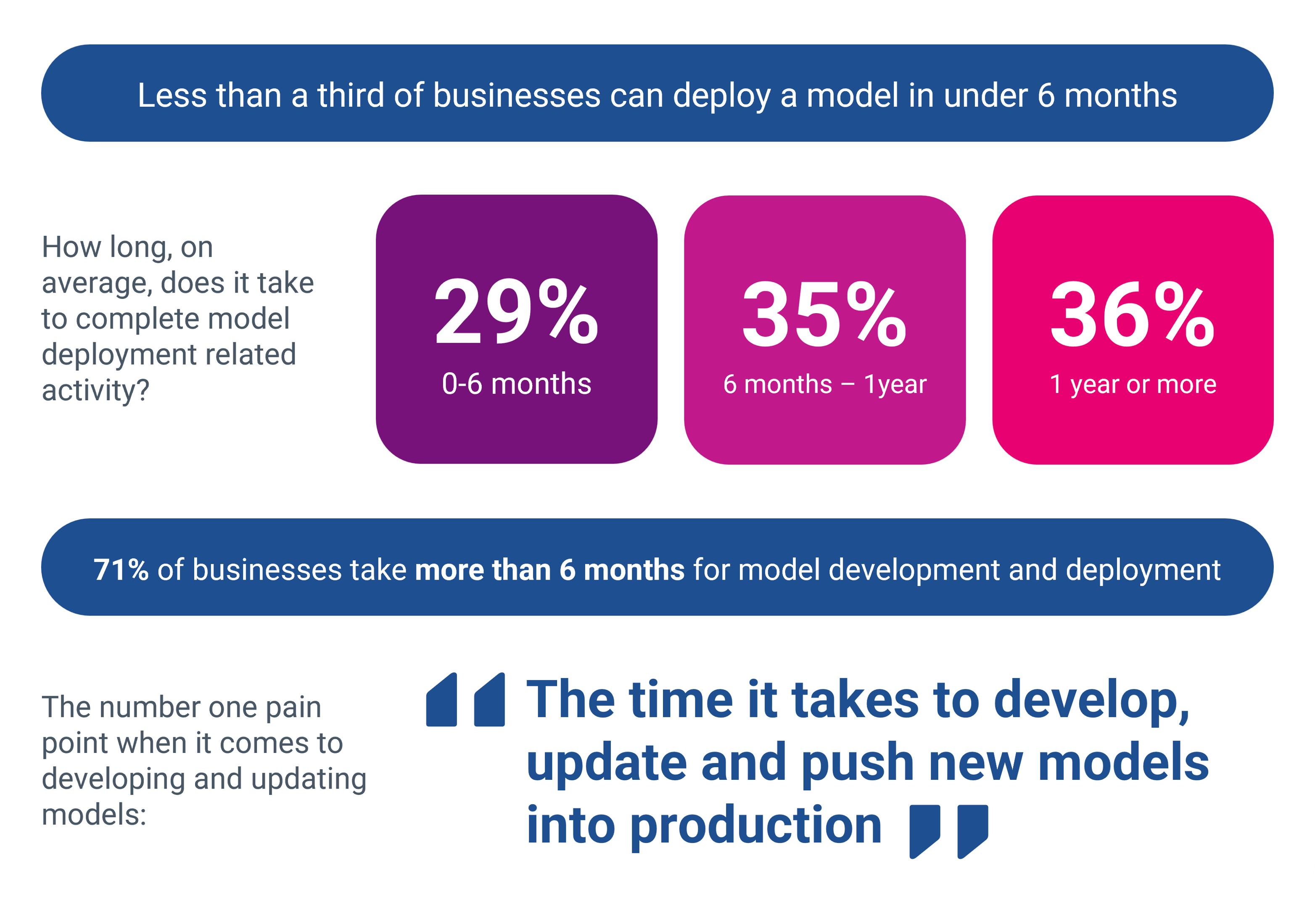
Model deployment speed is an important capability as it enables organisations to start benefiting from any improvement faster. However, research with Forrester Consulting shows that less than a third of businesses (29%) can deploy a model into decisioning in under six months. With close to three-quarters (71%) taking more than six months.

View full report

The impact of common model deployment and monitoring challenges

Challenge Impact
Long deployment cycles 6 - 18 months Degraded model accuracy, delayed ROI
Recoding models for production Increased cost, increased risk or errors
Lack of monitoring and governance Regulatory non-compliance
Siloed data and tooling Inefficient workflows, poor collaboration between teams

What is Ascend Model Ops?

Ascend Model Ops is Experian's solution for deploying, monitoring and governing analytical models. It supports the operational activities associated with moving supported models towards production, maintaining oversight after deployment and managing governance requirements over time. By bringing these activities into a managed environment, teams can improve visibility across model versions, supporting artefacts, approvals, deployment status and ongoing performance.

Register and document models

Register and document models

Register models alongside methodology information, approvals, test results and supporting documentation. A central record improves visibility and traceability across analytics, technology, model risk and governance teams. It also provides a consistent reference for model ownership, status and supporting evidence.

Manage model versions

Manage model versions

Track changes while retaining access to version histories and associated information. This helps teams understand which model is approved, which version is operating in production and what changed between releases.

Deploy models into production

Deploy models into production

Support deployment through a managed process designed to reduce reliance on fragmented workflows and manual handovers. For supported models, managed packaging and runtime capabilities can reduce the need for a separately recoded implementation. The precise process will depend on the model language, use case and configuration.

Connect to decisioning

Connect to decisioning

Make the production model available through a secure endpoint that can be called by supported decisioning software. The model output can then be incorporated into relevant policy, segmentation, strategy and workflow, subject to the organisation’s decisioning design and governance requirements.

Monitor performance and model drift

Monitor performance and model drift

Maintain visibility of model performance and changes in behaviour or underlying data. Monitoring can help teams identify conditions that warrant investigation, validation, recalibration or a new model version.

Support governance, audit and compliance activity

Support governance, audit and compliance activity

Maintain model records, documentation, approvals, tests and version histories within a common environment. This can support internal oversight, audit activity and applicable model-governance processes by reducing the need to assemble evidence from separate repositories.

Ascend Model Ops integration with Experian’s modelling ecosystem

Model deployment is influenced by activities that occur before and after production, including data access, model development, governance and decision execution. As part of the Ascend Platform, Ascend Model Ops can connect with relevant analytical and decisioning capabilities. This supports greater continuity between model development, deployment, operational use and ongoing monitoring.

Ascend Analytical Sandbox and Ascend Model Ops

Ascend Analytical Sandbox and Ascend Model Ops

Reducing the operational distance between model development and deployment

Ascend Analytical Sandbox supports data preparation, model development, testing and analytical validation.

When a model is ready to progress, Ascend Model Ops supports the next operational stages, including registration, controlled testing, deployment and monitoring. Used together, the solutions can reduce disconnected handovers between the analytical workspace and production operations.

Ascend Model Ops and Decisioning on Ascend Platform

Ascend Model Ops and Decisioning on Ascend Platform

Connecting analytical models with operational decision strategies

A deployed model influences decisions through the policy, strategy and workflow that use its output.

Ascend Model Ops can connect supported production models with Experian PowerCurve decisioning software. The model output can then be used within segmentation, policy rules, cut-offs and strategy flow, creating a more direct relationship between the approved model, its production implementation and the decision strategy using it.

Is Ascend Model Ops right for your organisation?

Ascend Model Ops may be relevant if your organisation:

Relies on recoding before analytical models can be deployed

Repeats testing after technical translation or packaging

Coordinates deployment through email, documents or spreadsheets

Maintains artefacts and version records across several repositories

Has limited visibility of which model version is approved or operating

Finds model monitoring inconsistent or resource-intensive

Requires significant manual effort to prepare governance or audit evidence

Expects its model portfolio to grow faster than current processes can support

Wants a clearer connection between approved models and operational decisioning

Would you like more information?

Please complete the form below and a member of our team will be in touch shortly.

I agree to receive communications from Experian about products or services that may be of interest *

By completing and submitting this online form, you consent to Experian collecting, holding, and using your personal information (Information) for the purpose of providing communications about this information, product or service. For more information on how we collect, use, and manage your Information please review our Privacy Policy. Additionally, if you have opted in, we will communicate with you about other products or services that may be of interest to you. You may opt out of receiving communications from us at any time. 

This site is protected by reCAPTCHA and the Google Privacy Policy and Terms of Service apply.

Ascend Model Ops frequently asked questions

Model Operations, commonly referred to as ModelOps, is the management of model registration, testing, deployment, versioning, monitoring and governance throughout the operational lifecycle. 

Ascend Model Ops helps organisations manage the operational complexity between model approval, production deployment and ongoing monitoring. 

Ascend Model Ops supports no-code deployment. For supported models, the original model code and dependencies can be packaged within a managed runtime and made available through a standard interface rather than being rewritten within the decisioning platform.

Models may be developed in an organisation's internal analytical environment, by a third party or through Experian analytical services, subject to supported formats and technical requirements. 

Models can be exposed through application programming interfaces for use by supported decisioning software. The integration approach depends on the client environment and technical design. 

Experian Ascend Model Ops manages the operational lifecycle of supported models, including registration, testing, deployment, version management, monitoring and governance. 

Experian Ascend Data Hub makes available data and analytical models easier to discover and connect. Read more about Ascend Data Hub [here].