
Ascend Platform
A unified platform that brings together data, analytics, decisioning, model operations, identity and fraud capabilities
A unified platform that brings together data, analytics, decisioning, model operations, identity and fraud capabilities
Many organisations have access to more data, analytics and AI-driven insights than ever before. The challenge is turning that intelligence into operational decisions that improve customer outcomes, manage risk and drive measurable business value.
The Ascend Platform brings together data, analytics, model operations, decisioning, identity and fraud capabilities within a unified, cloud-native platform. Instead of accessing multiple disconnected solutions, clients can work through a single platform that is designed for scalability, security and continuous innovation.
Whether supporting consumer or commercial customers, the Ascend Platform connects data with the technology used to discover, enrich and apply it across the customer lifecycle. Integrating data with analytics, models and decisioning workflows helps teams execute tasks more efficiently, respond to market change with agility and maintain high standards of data quality and governance.
73%
of financial institutions prioritise real-time decisioning
43%
identify fragmentation between systems as a significant challenge
Source: Connected Intelligence: Scaling AI with Trusted Data and Decisioning
86%
agree that transparency of analytics and insights is critical to improving decisions
Agility is often discussed as a strategic objective. In practice, it depends on the ability to move efficiently from identifying a change to implementing an appropriate response.
The need for that response may arise from changing customer behaviour, shifts in portfolio performance, emerging fraud threats, evolving regulatory requirements or new analytical evidence. Responding effectively requires a series of activities spanning analysis, strategy, governance and execution.
Identify emerging opportunities, risks and customer trends by bringing together information that often sits across multiple systems, teams and data sources.
Assess potential responses, test different approaches and determine which actions are most likely to create commercial, customer or risk-management value.
Validate proposed changes, align stakeholders and satisfy governance requirements before strategies, models or policies move into production.
Translate strategy into operational processes, customer journeys and decision workflows without creating unnecessary delays or implementation complexity.
Continuously track performance, identify changing conditions and understand whether strategies continue to deliver the outcomes they were designed to achieve.
Apply lessons from real-world performance to refine future strategies, creating a continuous cycle of learning and improvement across the customer lifecycle.

Agentic AI can enable organisations to coordinate complex tasks and workflows across data, tools and decisioning systems. This is particularly important in regulated environments, where access to data and tools must operate within appropriate security, permission and governance controls, and where decisions may need to remain explainable and auditable.
Connecting AI agents individually to the data, tools and workflows they need can require bespoke integration work. Model Context Protocol (MCP) addresses this challenge by providing an open standard for connecting AI applications with external systems, reducing the need to develop and maintain separate integrations.
Through MCP connectivity, the Ascend Platform can connect agentic AI with relevant data, tools and governed decisioning capabilities. This can create opportunities to coordinate more complex workflows while maintaining the controls and oversight required for operational decisions.
Speak to an Experian expert to find out more about agentic AI connectivity to the Ascend Platform.
The quality of an analytical model, fraud control or customer strategy depends on the information available to it. Experian combines credit, identity, fraud and alternative data with the analytical and operational capabilities required to evaluate that information and apply it within business processes.
Bringing these elements together can create a more direct path from accessing data to using it within models, strategies and customer journeys.
Acquisition, credit risk, fraud, customer management and collections are often managed by different functions, but their decisions frequently affect the same customers and portfolios.
Experian brings data, technology and domain expertise to each of these areas. This breadth allows organisations to address a specific priority while considering the dependencies and consequences elsewhere in the customer lifecycle.
Introducing new capability is one part of improving performance. The capability must also work with the organisation's existing data, models, policies, workflows and technology environment.
The Ascend Platform provides a common operating context for Experian solutions, reducing the need to connect each capability through entirely separate processes and integrations. Its open and extensible design can also support integration with selected systems, tools and third-party data sources where configured.
The growing use of advanced analytics, machine learning and automation is increasing the importance of model oversight, explainability, monitoring and auditability.
Solutions on the Ascend Platform support governance throughout relevant analytical and operational processes, from managing access and model versions to documenting approvals and monitoring production performance, providing the controls required in complex and regulated environments.
183%
return on investment
12%
improvement in approval rates
67%
improvement in credit decisioning efficiency
20%
reduction in default costs
The study also found that participating clients often began with one business requirement or capability before extending their use of Experian solutions. This provides a practical model for adoption: address the immediate priority, then consider adjacent capabilities where there is a clear operational or commercial case.
The Total Economic Impact study was conducted by Forrester Consulting and commissioned by Experian. Findings are based on a composite organisation and should not be interpreted as guaranteed outcomes for individual organisations.
The Ascend ecosystem brings together a range of solutions designed to support different stages of the journey from insight to execution. Explore the capabilities below to see how organisations are applying data, analytics and decisioning across the customer lifecycle, with the flexibility to extend and connect additional capabilities as requirements evolve.
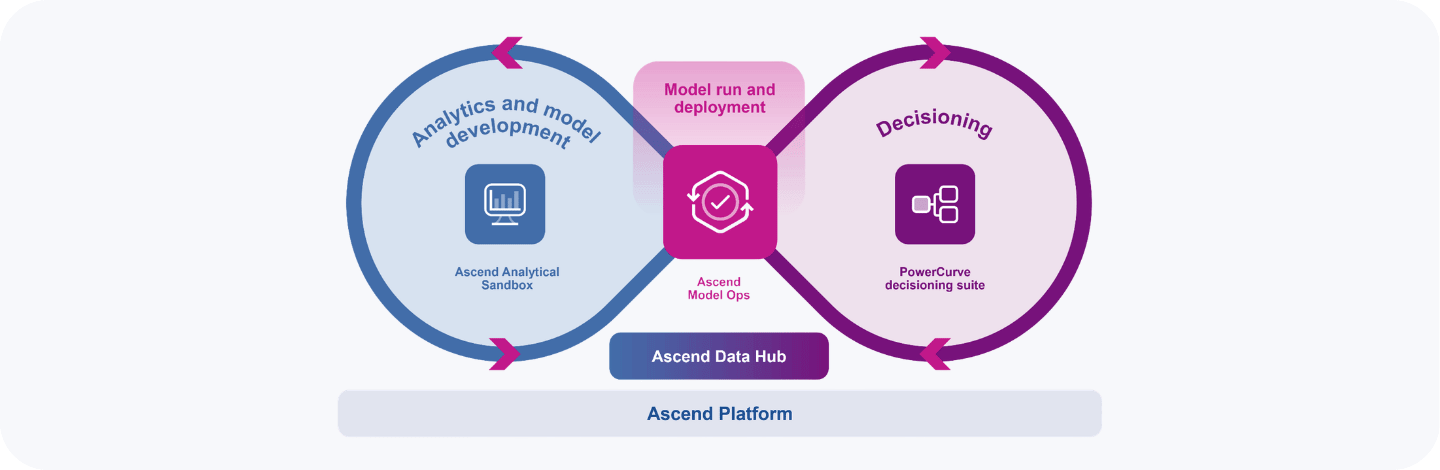

Identify and qualify evidence for growth, portfolio and risk strategy

Manage model deployment into decisioning strategies efficiently

Apply data assets, models and policies within operational decisions

Banks and credit providers can use capabilities on the Ascend Platform to examine customer acquisition performance, identify and verify consumer and business customers, introduce additional data into credit strategies, deploy and monitor models, manage portfolios, coordinate fraud controls and refine collections approaches. Identity capabilities can also support KYC and KYB processes associated with relevant anti-money laundering obligations.

Telecommunications providers can use the Ascend Platform capabilities to apply data, identity, fraud and strategy capabilities across digital onboarding, affordability assessment, device financing, account management, collections and customer retention.

Utility providers can use the Ascend Platform’s data and analytics capabilities to support customer identification and inform onboarding, affordability and payment strategies. Strategy-management capabilities can also assist teams in reviewing customer circumstances, prioritising accounts and applying appropriate engagement approaches consistently.

Insurers can use the Ascend Platform to connect data enrichment, identity verification, fraud assessment and analytical capabilities across quote and bind, customer onboarding, policy management and claims-related processes.

Fintechs and alternative finance providers can use solutions on the Ascend Platform to refine customer acquisition and fraud strategies as volumes, products and customer segments change. Relevant capabilities include identity verification to support anti-money laundering obligations, data evaluation, model development, automated decisioning and strategy management.
This site is protected by reCAPTCHA and the Google Privacy Policy and Terms of Service apply.
The Experian Ascend Platform is a unified, cloud-native platform that brings together data, analytics, model operations, decisioning, identity and fraud capabilities. Instead of accessing multiple disconnected solutions, clients can work through a single platform designed for scalability, security and continuous innovation.
Solutions on the Experian Ascend Platform can support customer acquisition, portfolio management, data integration, analytics, model deployment, identity verification, fraud prevention, customer management and collections.
No, the Experian Ascend Platform is the ecosystem and shared technology foundation behind a range of Experian products. Organisations typically engage with the product or proposition that addresses a specific business requirement.
Not necessarily. Experian solutions can operate within complex technology environments and can support integration with existing systems, third-party tools and external data sources, depending on the product and configuration.
Yes. An organisation may begin by addressing a specific requirement, such as data integration, model deployment or customer acquisition. Additional solutions can be introduced where there is an established business or operational case.
PowerCurve Decisioning is a core capability within the Experian Ascend Platform, enabling organisations to design, deploy, execute and optimise decision strategies. The Ascend Platform provides the cloud-based foundation that connects PowerCurve with data, analytics, model operations, fraud and identity services and governance within an integrated ecosystem.
Experian Ascend Platform supports organisations across financial services, telecommunications, utilities, insurance, fintech and other industries where data, analytics and operational processes need to work together effectively.
Although the business challenges vary by sector, many organisations are seeking to solve similar underlying problems: responding more quickly to change, improving operational efficiency and creating a clearer path from insight to execution.